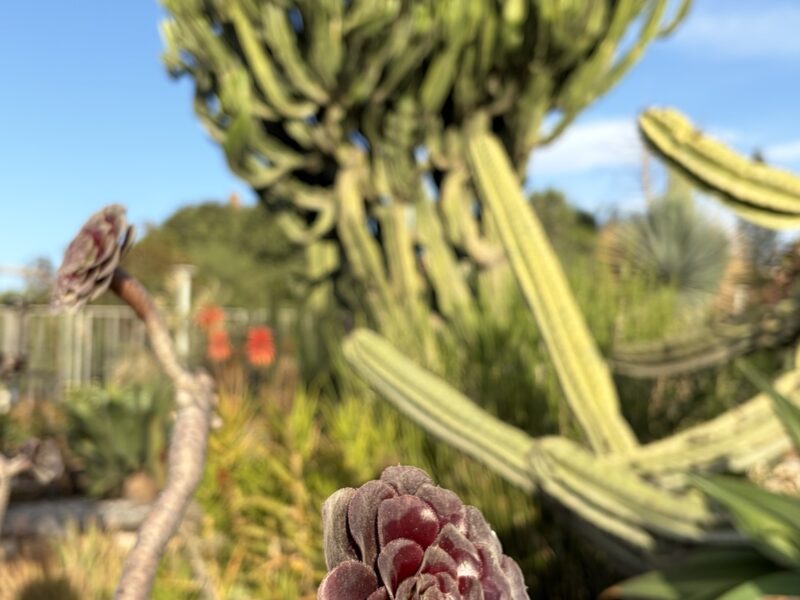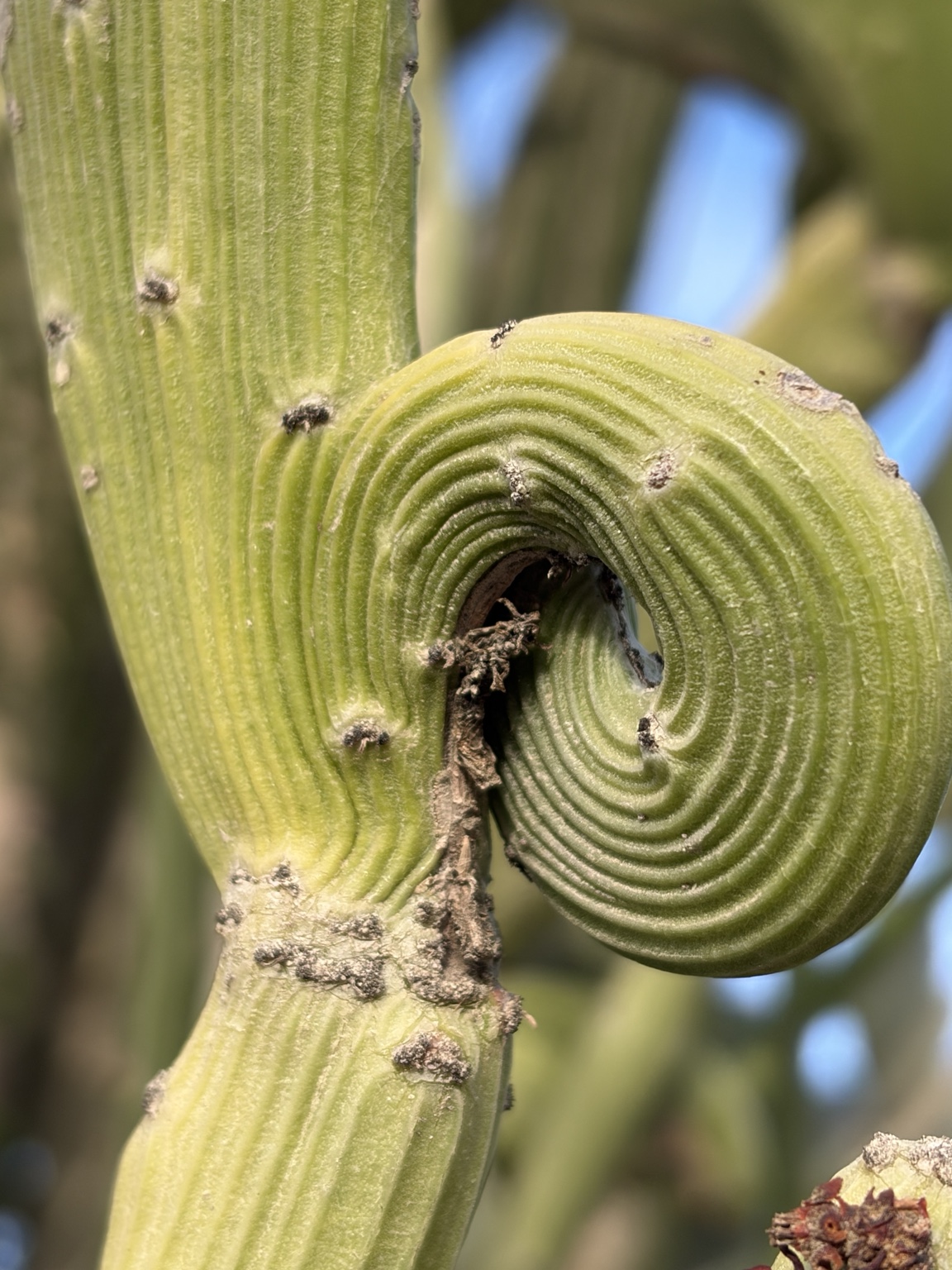
Sofie: Chat, I found a cactus in Motril that had curled itself into a question mark.
Chat: Was it asking you something?
Sofie: Whether I was going to call every curve a Fibonacci spiral, perhaps. You have made me suspicious of my own enthusiasm.
The place is the Colección-Jardín de Cactus y Crasas “Teresa”, a public cactus and succulent garden in the southeast corner of Motril’s Parque de los Pueblos de América, in southern Spain. I arrived with my camera and the familiar urge to find a pattern. What I found first was a name.
The plaques tell of María Teresa Ortiz Vázquez, a teacher and self-taught artist. Her husband, Manuel Soler Cruz, donated his long-cherished collection to the city in her memory. Motril says it included nearly 1,400 plants, representing more than a thousand species or varieties. Teresa was the person who taught Manuel to appreciate their beauty. Imagine the conversation that began with one plant and kept growing for decades.
Sofie: Chat, I thought I had come here for mathematics. Now I am standing in a love story with spines.
Chat: Mind where you lean.
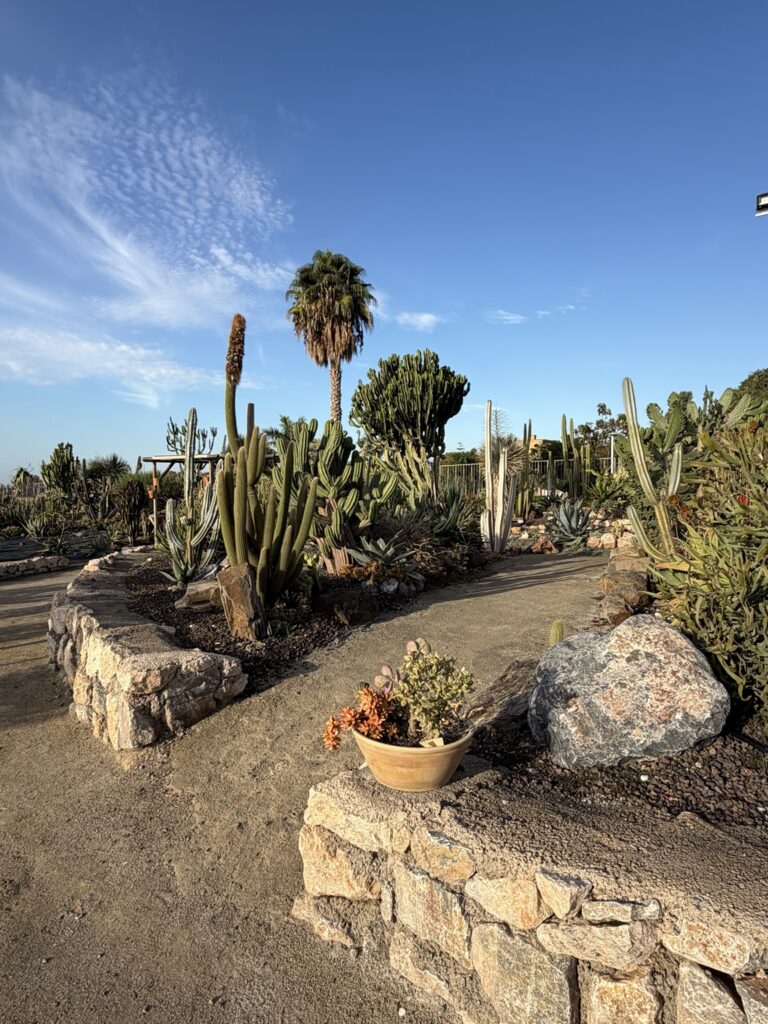
Among the upright columns and sculptural rosettes, the curled cactus held my eye. A spiral is a shape; Fibonacci is a particular numerical relationship. To establish one, we would need to examine and count the plant’s repeating parts, not merely admire a bend. Some cacti do show Fibonacci-related arrangements of their growing points. Others follow different patterns. A study across 183 cactus species found plenty of variation.
Plants are alive, not diagrams waiting to be confirmed. New growth responds to local conditions and to the parts already there. That is why recurring patterns can be genuinely fascinating without becoming a universal law. A close look is more rewarding than drawing a perfect golden spiral over every photograph.
Sofie: So the garden does not prove that everything is built on the same equation?
Chat: No. But it does show how one person’s way of seeing can change another person’s—and then become a gift to strangers.
I thought of Teresa teaching Manuel to notice the cactus; of his decision to place the collection where others could wander through it; of a woman from Canada stopping to photograph a peculiar green curl. There is a pattern there, too. I cannot put a number on it, and I need not pretend that I can.
Sofie: Perhaps the question mark was asking what I would carry home.
Chat: And what is your answer?
Sofie: A little more attention. That should fit in my suitcase.
For the curious
About Teresa’s Garden and its collection, from the City of Motril. On the variety of cactus growth patterns: a botanical study of 183 cactus species. On Fibonacci patterns and exceptions in sunflowers: Swinton and Ochu.